VLEO2ABEP: What We Learned and Where We Go Next |
| 11 September 2026, Friday, 2:30pm to 3:00pm | Speaker: Dr. Chan Wai Lee, Senior Lecturer, Singapore University of Technology & Design |
| Venue: Seminar Room 8D-1, Level 8, Temasek Laboratories | Event Organiser Host: Dr. Sai Sudha Ramesh |
|
ABSTRACT |
Very low Earth orbit (VLEO) offers compelling advantages for satellite missions, including higher-resolution Earth imaging, lower communication latency, and natural debris mitigation. The price, however, is a demanding environment where atmospheric drag, in particular, can strongly constrain VLEO spacecraft lifetime. Our work on VLEO therefore evolved from understanding spacecraft aerodynamics to a design question: Can the atmosphere itself become part of the solution? This talk traces that endeavor to atmosphere-breathing electric propulsion (ABEP), which seeks to capture residual atmospheric particles and use them as propellant for continuous drag compensation, potentially removing onboard propellant as a limiting factor of VLEO spacecraft. The challenge is that ABEP is fundamentally a system-integration problem where multiple disciplines are tightly coupled. To navigate this design space, we propose an integrated computational framework to examine if thrust can close the drag budget, along with an outlook on how increasingly capable, multi-fidelity particle-based simulations and emerging particle-based artificial intelligence may enable practical exploration at scale. |
| ABOUT THE SPEAKER |
|

Electric Propulsion in Space: From Principles to Simulations of Hall Thrusters |
| 11 September 2026, Friday, 3:00pm to 3:30pm | Speaker: Dr. Simone Di Fede, Space System Engineer, Aliena |
| Venue: Seminar Room 8D-1, Level 8, Temasek Laboratories | Event Organiser Host: Dr. Sai Sudha Ramesh |
|
ABSTRACT |
Space exploration is entering a new era where small satellites and miniaturized thrusters have gained increasing importance. This presentation provides a fundamental overview of electric propulsion, examining its distinct advantages over chemical propulsion systems. The discussion will focus specifically on the Hall Effect Thruster (HET), widely considered the "workhorse" of modern electric propulsion, and will include an overview of MUSIC — one of the few commercially available low-power Hall thrusters, developed by Aliena in Singapore. |
| ABOUT THE SPEAKER |
|

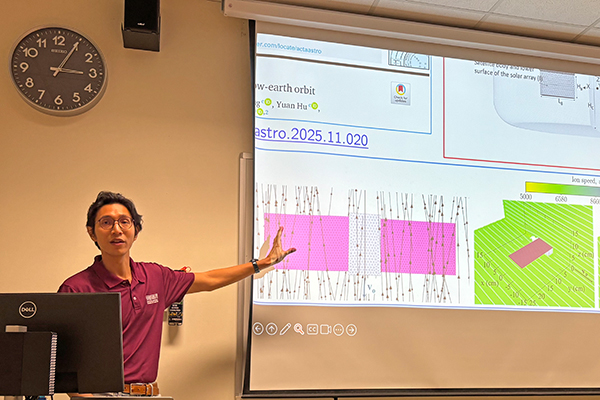
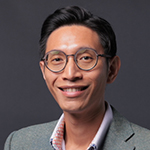 Dr. Chan Wai Lee is a Senior Lecturer in Engineering Product Development at the Singapore University of Technology & Design and an Aero(+)Space researcher working at the intersection of aerospace flow modeling, aerodynamics, and physics-based artificial intelligence. He received his Ph.D. in Aerospace Engineering from the University of Michigan and was previously a postdoctoral researcher at Stanford University and faculty member at Nanyang Technological University, Singapore. His recent work spans VLEO spacecraft, gas-surface interactions, and computational methods for designing and understanding next-generation aerospace systems.
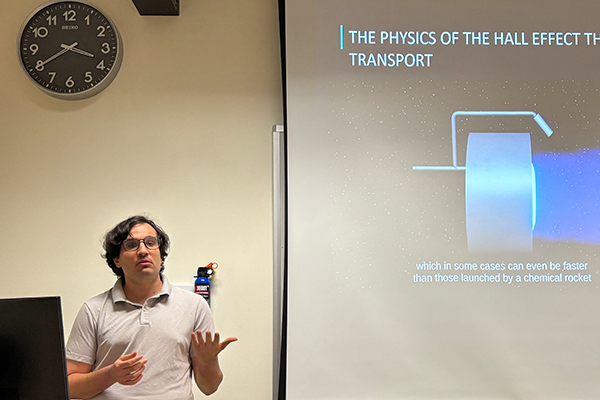
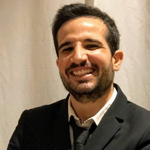 Dr. Simone Di Fede earned a Master’s degree as an ingénieur généraliste from École Centrale Paris and a Master’s in Aerospace Engineering from the University of Padua. He previously worked as a thermal engineer for Thales Alenia Space before joining the Space Propulsion Group in Padua to complete his PhD. Following his doctoral studies, he moved to Singapore to work as a Research Fellow at Nanyang Technological University. He currently serves as a Space System Engineer at Aliena.