From Centralized to Distributed - The Evolution of Ground Multi-Robot Exploration |
| 12 June 2026, Friday, 3:30pm to 4:00pm | Speaker: Dr. Billy Pik Lik Lau, School of Electrical and Electronic Engineering, Nanyang Technological University (NTU) |
| Venue: Seminar Room 8D-1, Level 8, Temasek Laboratories | Event Organiser Host: Dr. Sai Sudha Ramesh |
|
ABSTRACT |
Multi-robot exploration in unfamiliar environments requires strategies that are efficient, robust, and aware of communication constraints. Current frontier-based Rapidly-Exploring Random Tree (RRT) methods are hindered by their greedy selection of frontiers and their dependence on centralized, fully connected systems, which restricts their performance in scenarios with limited communication. This talk introduces the evolution of RRT exploration architecture and algorithm designed for multi-robot systems. Here, an improved centralized Temporal Memory-based RRT(TM-RRT) exploration is presented, along with edge capability exploration that support multi-robot operation. Lastly, a Distributed and Communication-aware Temporal Memory-based RRT exploration strategy is presented, which implements a relative pose transformation for efficient inter-robot information sharing, utilizing Voronoi-based frontier partitioning for collaborative zone distribution, and incorporating a past-trajectory-aware cost function to reduce exploration overlap. A stuck recovery mechanism is included to guarantee ongoing exploration, even when individual AGVs deplete their designated frontiers. By sharing only three minimal ROS topics, DCTM-RRT achieves a data transmission reduction of 19.12× to 24.93× compared to existing approaches. Comprehensive simulations and real-world tests reveal improvements in exploration time ranging from 137.19% to 209.61% over leading baselines, with a 100% success rate across all evaluated fleet configurations. |
| ABOUT THE SPEAKER |
|

A Perception-Enhanced Drone Endoscope System for Near-Surface Observation in Fusion Reactor Vacuum Chambers |
| 12 June 2026, Friday, 4:00pm to 4:30pm | Speaker: Professor Ji Aihong, College of Mechanical and Electrical Engineering, Nanjing University of Aeronautics and Astronautics |
| Venue: Seminar Room 8D-1, Level 8, Temasek Laboratories | Event Organiser Host: Dr. Sai Sudha Ramesh |
|
ABSTRACT |
The talk will introduce a novel drone endoscope system (DES) for internal observation in fusion reactors. The system has been applied to the inspection of a 1/8 vacuum chamber of the China Fusion Engineering Test Reactor (CFETR), successfully achieving autonomous localization and mapping in a narrow and confined vacuum chamber under Global Navigation Satellite System (GNSS)-denied and dark conditions. This study provides a new technical approach for internal observation missions in fusion reactors and can be further extended to flight inspection tasks inside other narrow vacuum chambers of fusion reactors.
|
| ABOUT THE SPEAKER |
|


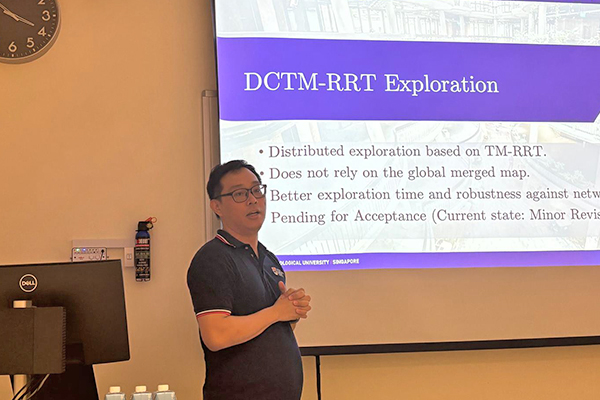
 Billy Pik Lik Lau (Senior Member, IEEE) earned his Ph.D. from the Singapore University of
Technology and Design (SUTD) in 2021, his M.Phil. in Computer Science from Curtin University Sarawak Malaysia in 2014, and his B.Sc. in Computer Science from the same university in 2010. His doctoral research concentrated on data fusion and big data analytics within urban science and the Internet of Things. Following his postdoctoral work, he investigated multi-robot systems design, integrating elements from both his master's and doctoral studies. Currently, he is a Postdoctoral Fellow at the School of Electrical and Electronic Engineering, Nanyang Technological University (NTU), where he acts as a technical lead in his team for the multi-robot project, focusing on the development of lightweight detection methods for UAV flight operations. His research interests include multi-robot exploration, multi-agent systems, sensor fusion, and the application of machine learning in real-world autonomous systems. He has authored over 25 journal articles and 14 conference papers. Additionally, he holds the position of Associate Editor at Springer Nature Computer Science and actively reviews for several leading IEEE journals.
Billy Pik Lik Lau (Senior Member, IEEE) earned his Ph.D. from the Singapore University of
Technology and Design (SUTD) in 2021, his M.Phil. in Computer Science from Curtin University Sarawak Malaysia in 2014, and his B.Sc. in Computer Science from the same university in 2010. His doctoral research concentrated on data fusion and big data analytics within urban science and the Internet of Things. Following his postdoctoral work, he investigated multi-robot systems design, integrating elements from both his master's and doctoral studies. Currently, he is a Postdoctoral Fellow at the School of Electrical and Electronic Engineering, Nanyang Technological University (NTU), where he acts as a technical lead in his team for the multi-robot project, focusing on the development of lightweight detection methods for UAV flight operations. His research interests include multi-robot exploration, multi-agent systems, sensor fusion, and the application of machine learning in real-world autonomous systems. He has authored over 25 journal articles and 14 conference papers. Additionally, he holds the position of Associate Editor at Springer Nature Computer Science and actively reviews for several leading IEEE journals.
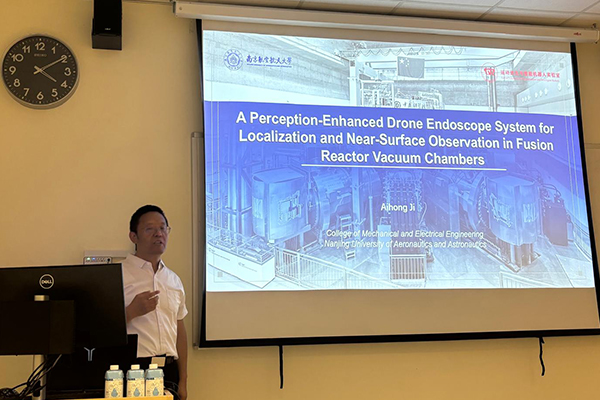
 Dr. Ji Aihong is currently a Professor at the College of Mechanical and Electrical Engineering, Nanjing University of Aeronautics and Astronautics, Nanjing, China, and serves as Director of the Jiangsu Provincial Key Laboratory of Bionic Materials and Equipment. He received his Ph.D. degree from Nanjing University of Aeronautics and Astronautics in 2007. He leads the Lab of Locomotion Bioinspiration and Intelligent Robots, which currently has four research staff members and approximately 40 doctoral and master’s students. He has undertaken numerous national-level research projects. His research interests include intelligent robotics, unmanned aerial vehicles, and smart equipment development.