
Flow Past a Bluff Body: High-fidelity Simulation and Intelligent Flow Control |
| 4 April 2025, Friday, 2:30pm to 3:00pm | Speaker: Associate Prof. Ren Feng, School of Marine Science and Technology, Northwestern Polytechnical University |
| Venue: Seminar Room 8D-1, Level 8, Temasek Laboratories | Event Organiser Host: Dr. Huang Xin |

ABSTRACT |
Flow past a bluff body represents one of the most fundamental and widely studied phenomena in fluid mechanics, ubiquitous in nature and engineering applications. To resolve the intricate spatiotemporal evolution of flow structures and uncover the underlying physics, a high-fidelity numerical framework is presented that leverages the lattice Boltzmann method, integrating the immersed boundary method, large eddy simulation, a nonuniform mesh partitioning technique, together with the GPU parallel technique for ultrafast computations. Based on this solver, we demonstrate intelligent flow control strategies targeting drag reduction, vibration suppression, noise mitigation, and hydrodynamic stealth. A deep reinforcement learning (DRL) approach is implemented to design the closed-loop control system. For instance, in flow past a circular cylinder, windward-suction-leeward-blowing actuators dynamically regulate near-wall flow behavior, while velocity sensor arrays supply real-time feedback. After 1,000 training episodes, the DRL agent derives an optimal control policy that eliminates wake signatures and achieves hydrodynamic stealth. In summary, this talk delivers a high-fidelity, computationally efficient framework for bluff body flow analysis, providing scalable solutions with affordable computational time and hardware cost, enabling practical applications of intelligent closed-loop flow control in complex fluid systems. |
| ABOUT THE SPEAKER |
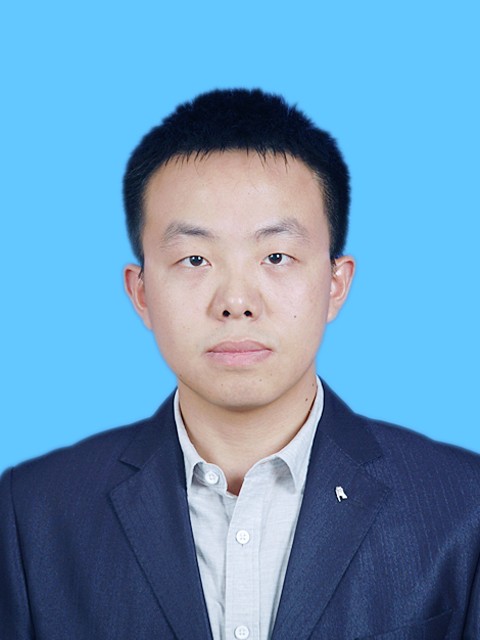 The speaker is currently an Associate Professor at the School of Marine Science and Technology, Northwestern Polytechnical University (NPU). He earned his Bachelor’s degree (2013) and Ph.D. (2018) from NPU, where his doctoral dissertation was honored as an Outstanding Doctoral Dissertation of Shaanxi Province. From 2018 to 2020, he conducted postdoctoral research at The Hong Kong Polytechnic University. His research focuses on intelligent flow control and advanced numerical methods for complex fluid dynamics, with applications in turbulent flow, fluid-structure interaction, and heat transfer flow systems. To date, he has published over 20 peer-reviewed papers as first or corresponding author in top-tier fluid mechanics journals, including the Journal of Fluid Mechanics and the Journal of Computational Physics. He contributes to the academic community as an editorial board member of the Journal of Hydrodynamics and a guest editor for Actuators. Furthermore, he has led multiple research projects funded by the National Natural Science Foundation of China, the Key Research and Development Program of Shaanxi Province, etc. The speaker is currently an Associate Professor at the School of Marine Science and Technology, Northwestern Polytechnical University (NPU). He earned his Bachelor’s degree (2013) and Ph.D. (2018) from NPU, where his doctoral dissertation was honored as an Outstanding Doctoral Dissertation of Shaanxi Province. From 2018 to 2020, he conducted postdoctoral research at The Hong Kong Polytechnic University. His research focuses on intelligent flow control and advanced numerical methods for complex fluid dynamics, with applications in turbulent flow, fluid-structure interaction, and heat transfer flow systems. To date, he has published over 20 peer-reviewed papers as first or corresponding author in top-tier fluid mechanics journals, including the Journal of Fluid Mechanics and the Journal of Computational Physics. He contributes to the academic community as an editorial board member of the Journal of Hydrodynamics and a guest editor for Actuators. Furthermore, he has led multiple research projects funded by the National Natural Science Foundation of China, the Key Research and Development Program of Shaanxi Province, etc.
|


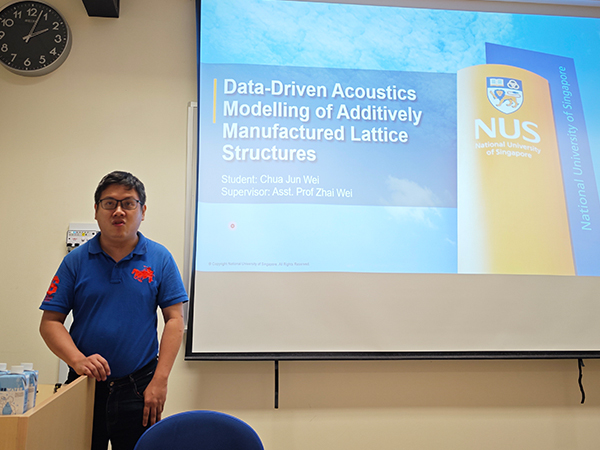
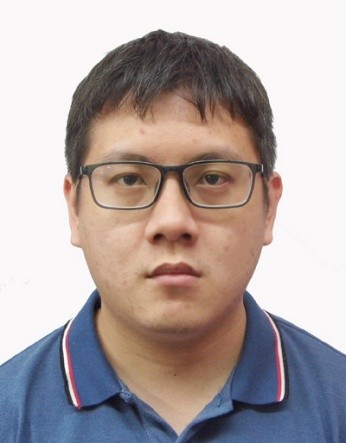 Mr. Chua Jun Wei is currently a PhD student in the Department of Mechanical Engineering, National University of Singapore. His research interests includes the design, modelling and optimization of novel acoustic materials such as foams, aerogels, acoustic metamaterials and lattice structures.