Experimental Methods for Multi-Propeller Noise Characterisation |
| 7 August 2026, Friday, 3:30pm to 4:00pm | Speaker: Mr. Yi Zilei, PhD Student, University of Bristol |
| Venue: Seminar Room 8D-1, Level 8, Temasek Laboratories | Event Organiser Host: Dr. Sai Sudha Ramesh |
|
ABSTRACT |
Multi-rotor/propeller systems, such as those found on eVTOL and DEP aircraft, produce significant levels of tonal noise governed by the acoustic interference and aerodynamic interactions between neighbouring rotors. This presentation reports experimental far-field noise of a multi-propeller system using two methodologies, in which the relative phase between propellers is either held constant or varied at a constant rate. Rotation speeds were precisely controlled in both configurations to resolve the phase-dependent noise modulation. The measured far-field noise is compared against a low-order model based on Hanson’s tonal noise formulation with reasonable agreement, although some discrepancies reveal additional noise potentially associated with aerodynamic interactions and not represented in the acoustic model. |
| ABOUT THE SPEAKER |
|

From Bio-Inspiration to Mission-Capable Flight: Development of Insect-Inspired Flapping-Wing Micro Air Vehicles |
| 7 August 2026, Friday, 4:00pm to 4:30pm | Speaker: Dr. Nguyen Quoc Viet, Senior Research Scientist, Temasek Laboratories, NUS |
| Venue: Seminar Room 8D-1, Level 8, Temasek Laboratories | Event Organiser Host: Dr. Sai Sudha Ramesh |
|
ABSTRACT |
Flapping-wing micro air vehicles offer several distinctive advantages at small scales, including high aerodynamic efficiency, agile manoeuvrability, relatively low acoustic signatures, and enhanced tolerance to collisions. Their practical development, however, remains challenging because of the complexity of flapping mechanisms and flight-control systems, as well as limitations in structural durability, payload capacity, and onboard sensing. This talk presents the development of a series of insect-inspired tailless flapping-wing micro air vehicles, progressing from fundamental mechanism design to mission-capable flying prototypes. |
| ABOUT THE SPEAKER |
|


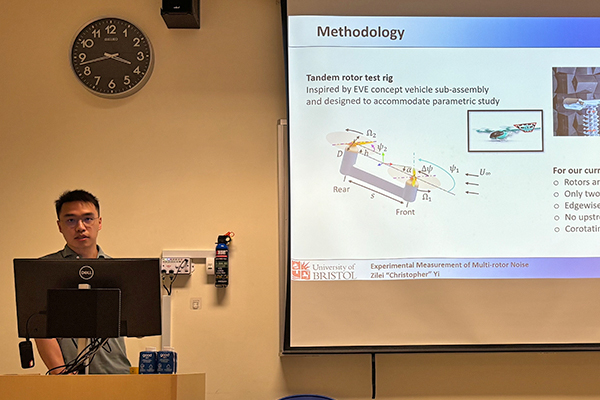
 Mr. Yi Zilei (Christopher) is a final-year PhD student in aerospace engineering at the University of Bristol. His project focuses on experimental noise characterisation of multi-propeller systems in non-axial inflows, with a sideline in low- to mid-fidelity numerical modelling. He works within the Aerodynamics and Aeroacoustics Research Group (A2RG) under the supervision of Dr Esmaeel Masoudi and Prof. Mahdi Azarpeyvand.
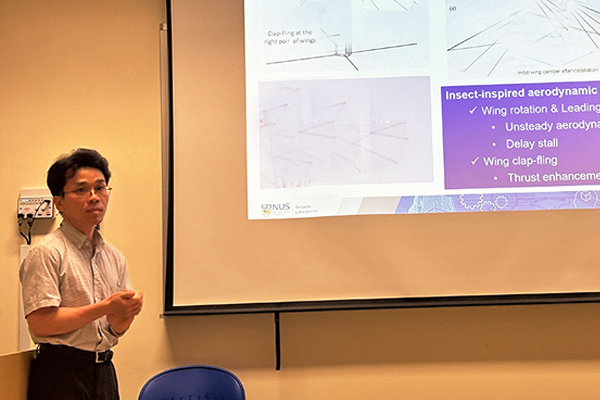
 Dr. Nguyen Quoc Viet joined TL@NUS in September 2012. He received his PhD in Aerospace and Mechanical Engineering in 2008 and subsequently conducted postdoctoral research at Konkuk University in South Korea. His research interests include the development of bio-inspired flapping-wing aerial vehicles, indoor flight navigation and control, and bio-inspired robotic systems.